Cells follow a precise internal timetable, controlled not only by DNA but also by epigenetic modifications. Axel Imhof studies how these mechanisms regulate cellular processes and preserve molecular memory – while still allowing flexibility.
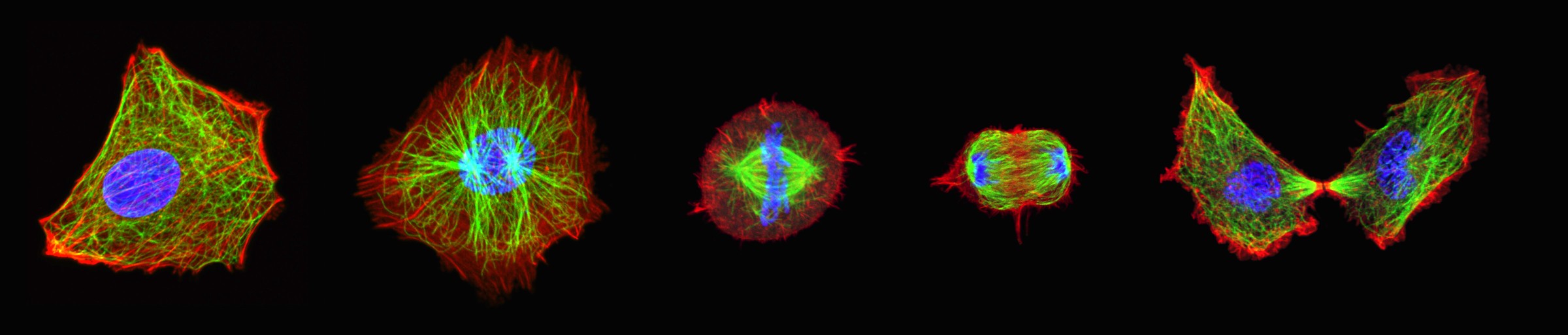
Various phases of cell division. During this process, the chromatin in the cell nucleus (blue) is restructured into chromosomes and distributed to the emerging daughter cells by the spindle apparatus (green).
Chromatin was long considered a total bore: a tightly packed complex of DNA and histone proteins whose main function, it seemed, was to keep the genetic material stowed away neatly in the cell nucleus. However, this view has fundamentally changed over recent decades. Today it is clear that chromatin is much more than that. It influences which genes are read and when – and is thus intimately connected with all processes in the cell.
Cells dance in step with their molecular machines. Their interiors are a ceaseless hive of activity where proteins are assembled and disassembled, genes are switched on and off, and signals are transmitted. Many of these processes must be precisely coordinated in time. This becomes particularly apparent during cell division: In clearly defined phases, the cell grows, duplicates its DNA, and distributes it to its daughter cells. Functions that are important for survival – such as hormone production and metabolic processes – follow a circadian rhythm, which is controlled by cellular ‘clocks’. But who sets these rhythms? And how can the cell respond flexibly to its environment in spite of them?
Molecular biologist Axel Imhof explores these questions. For the Professor of Protein Analytics at LMU Munich’s Biomedical Center, the answer lies in epigenetics: Although every cell in an organism carries the same genetic information, different genes are activated depending on the cell type and the timing. This is determined by epigenetic modifications: Certain enzymes transfer methyl, phosphate, or acetyl groups to the histone proteins around which the DNA in the cell nucleus is wrapped, which function like little ‘labels’ that determine how tightly the chromatin is packed. This packaging controls how accessible the genes are to the proteins that activate them. Its structure is not static, however, but can change and follow temporal dynamics.
Such dynamics generally operate via feedback loops, explains Imhof: “Certain proteins accumulate until they reach a critical threshold, whereupon they trigger the next set of reactions and are then broken down.” Cell division is a classic example: Here it is proteins known as cyclins that are rhythmically synthesized and degraded as the cell cycle progresses. In this way, they control the processes that reorganize chromatin structure and drive the cell through division.
Imhof was recently able to elucidate how the cell times this reorganization of its chromatin structure precisely to match the needs of cell division: Specific proteins are activated when the DNA has to be duplicated. These proteins organize the DNA packaging so that the cell’s “copying machine” can get to work. If this control fails, the duplication is delayed and the cell responds sensitively to disruptions.
Flexibility through forgetting
During cell division, it is essential for cells to preserve their identity. For a liver cell to ‘know’ that it is a liver cell, the epigenetic information also has to be passed on to the daughter cells. This creates a problem for the cell in that duplication of the genetic material requires twice as many histones – but the newly synthesized histones do not carry any epigenetic modifications yet. To make sure the cell can find and restore the correct epigenetic state at important genes, it places molecular “bookmarks” at key sites in the DNA. These marks guide the restoration of the proper modifications.
»For a liver cell to ‘know’ that it is a liver cell, the epigenetic information also has to be passed on to the daughter cells.«
Axel Imhof
However, the restoration of these epigenetic patterns does not necessarily happen in sync with cell division. To his surprise, Imhof discovered that the enzymes responsible for adding methyl groups to histones lag behind the cell cycle: “The DNA has long been copied and the cell is already in the next phase, while the methylations are added bit by bit until the new genes really look like the old ones,” explains the molecular biologist. At first glance, it can seem like a bug in the system when the cell initially “forgets” part of its identity after division. But Imhof believes this very lag could ultimately be an advantage: “It gives the cell a certain room for maneuver as regards remaining flexible and adapting to its environment.”
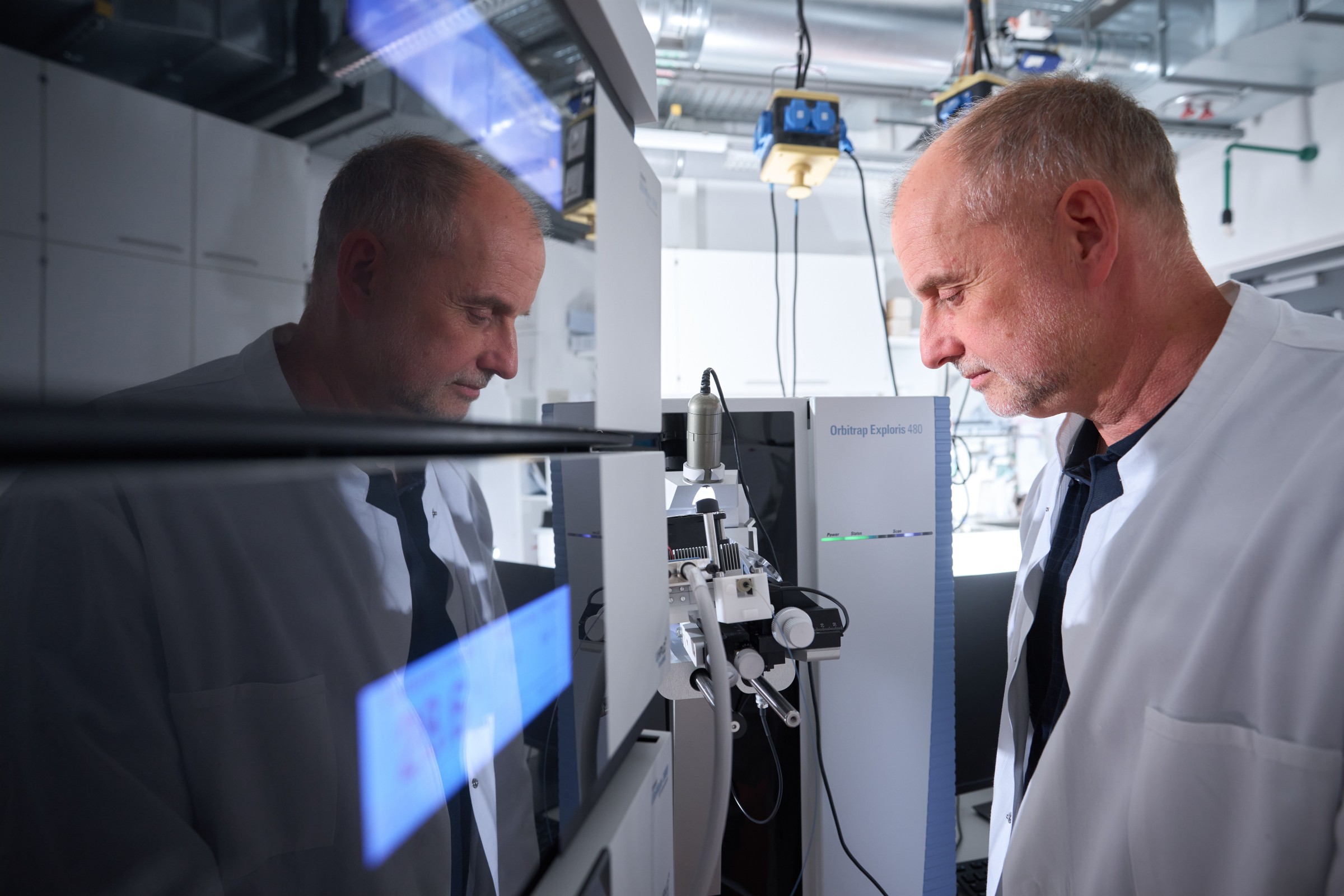
In the Central Laboratory for Protein Analytics, led by Axel Imhof, complete proteomes and complex protein mixtures can be analyzed using mass spectrometry.
In a striking experiment on fruit flies, Imhof’s team showed how epigenetic adaptations help organisms respond flexibly to their environment. Two early-career researchers from his group noticed that a certain histone modification in the insect’s genome increased markedly a short time before the populations died. This modification was caused by an enzyme called “chameau.” When the researchers suppressed the activity of chameau, the flies lived for longer. This raised the question as to why they have this enzyme in the first place?
»The DNA has long been copied and the cell is already in the next phase, while the methylations are added bit by bit until the new genes really look like the old ones.«
Axel Imhof
Chameau only reveals its utility when the flies are starving. In that condition, flies without chameau die much more quickly. “Clearly the enzyme is important for resilience when food is scarce,” says Imhof. Accordingly, it would seem that epigenetic factors can become important under particular circumstances, when they impart greater resilience.
Potential for diagnostics and therapy
If the precise temporal coordination of cellular processes is disrupted, the cell’s behavior and identity change. A good example is tumor cells, which divide much more quickly than healthy cells. “This triggers epigenetic instability,” explains Imhof. Because the time is lacking to correctly restore the necessary marks in the chromatin, key control mechanisms become confused. This can cause genes to be activated that should be silenced, or can prevent DNA damage from being reliably repaired – making the cells even more aggressive.
Such changes are often hard to recognize. After all, they are not based on mutations in the DNA code itself, but on changes in gene accessibility. Despite this difficulty, oncological approaches are emerging that seek to use epigenetic marks as biomarkers. For example, studies have shown that it may be possible to detect tumors at an earlier stage based on the evidence of histone modifications.
While Imhof still views this possibility with skepticism, he is more bullish about the use of such signatures for verifying the success of therapies. Many epigenetically active enzymes, such as methyl- or acetyltransferases, can be specifically inhibited in cancer therapy. Analyzing histone marks in the blood can therefore indicate whether, and how well, a treatment is working.
A key tool in Imhof’s research is mass spectrometry, which allows him to precisely identify and quantify proteins and their modifications. Imhof established the method at LMU and built up a Core Facility that is also available to other researchers. “We were one of the first laboratories worldwide to investigate histone modifications in detail using mass spectrometry,” he notes. Since then, the method has developed rapidly: “Whereas at the beginning we needed several hours to analyze a maximum of 400-500 proteins in one run, now we can identify 5,000-6,000 proteins in 20 minutes from relatively few cells.” This is complemented by imaging mass spectrometry, in which tissue sections are scanned point by point with a laser. “It’s like microscopy in a way – except that you can map thousands of features, giving a much greater level of complexity,” enthuses Imhof. The challenge has largely shifted from measurement to understanding: “We’re accumulating more and more data all the time. The big task now is to make sense of it all.”
»We were one of the first laboratories worldwide to investigate histone modifications in detail using mass spectrometry.«
Axel Imhof
The datasets could help clarify what is, for Imhof, one of the most exciting open research questions: the rules behind the molecular processes of life. Why is a gene expressed at a certain moment? Why do certain proteins bind only to selected DNA sites – and not to others with the same sequence? Although scientists are currently able to describe in detail when certain factors are active and, for instance, how an embryo develops into an organism, this knowledge remains largely descriptive; they have been unable to predict unknown processes from this information.
Imhof compares this to a language in which you know the words, but not the grammar. To close that gap, he is harnessing the power of AI and theoretical models. These tools could allow researchers to derive patterns from the ever-growing volumes of data. From these patterns, a set of rules could then emerge step by step. However, that goal is still a long way off. “It stretches out far beyond my retirement,” he laughs. In the meantime, chromatin – once dismissed as dull and uninteresting – may hold many more surprises in store.
Axel Imhof is Professor of Protein Analytics and head of the Core Facility Proteomics at LMU Munich’s Biomedical Center.
More Research and Innovation:
8 conductors of nature: Animals, plants, bacteria, and fungi have all developed strategies for adapting their lives to the rhythm of their environment. We present some of these conductors of life. Read now!
Against the clock: Sleep, hunger, alertness – the body’s natural processes are regulated throughout the day by our internal clock. But what happens when the body’s clock gets out of sync? Read now!